


November 16, 2026 Session Harvest: Egyptian Exchange in Defensive Selectivity Amid Global Headwinds - 16 November 2026
Executive Summary
Egyptian Exchange indices closed today's session with slight divergence in overall performance, with a clear tilt toward extreme selectivity in stock picking, reflecting cautious anticipation gripping both local and foreign investors alike. This comes as global markets witness a violent correction hitting tech giants led by Nvidia, amid mounting fears of more hawkish US monetary policy than anticipated, casting a heavy shadow on risk appetite in emerging markets.
The main market index EGX30 recorded a marginal decline to close at 30,450 points, while the small and mid-cap index EGX70 EWI managed marginal gains, supported by selective local flows into specific sectors. Total trading value reached approximately EGP 3.2 billion, below the monthly average, confirming the wait-and-see mode and profit-taking dominance on winning positions since the start of Q4.

First: Local Performance Drivers.. Between Banking Resilience and Real Estate Pressure
#### Banking Sector: Safe Haven and Liquidity
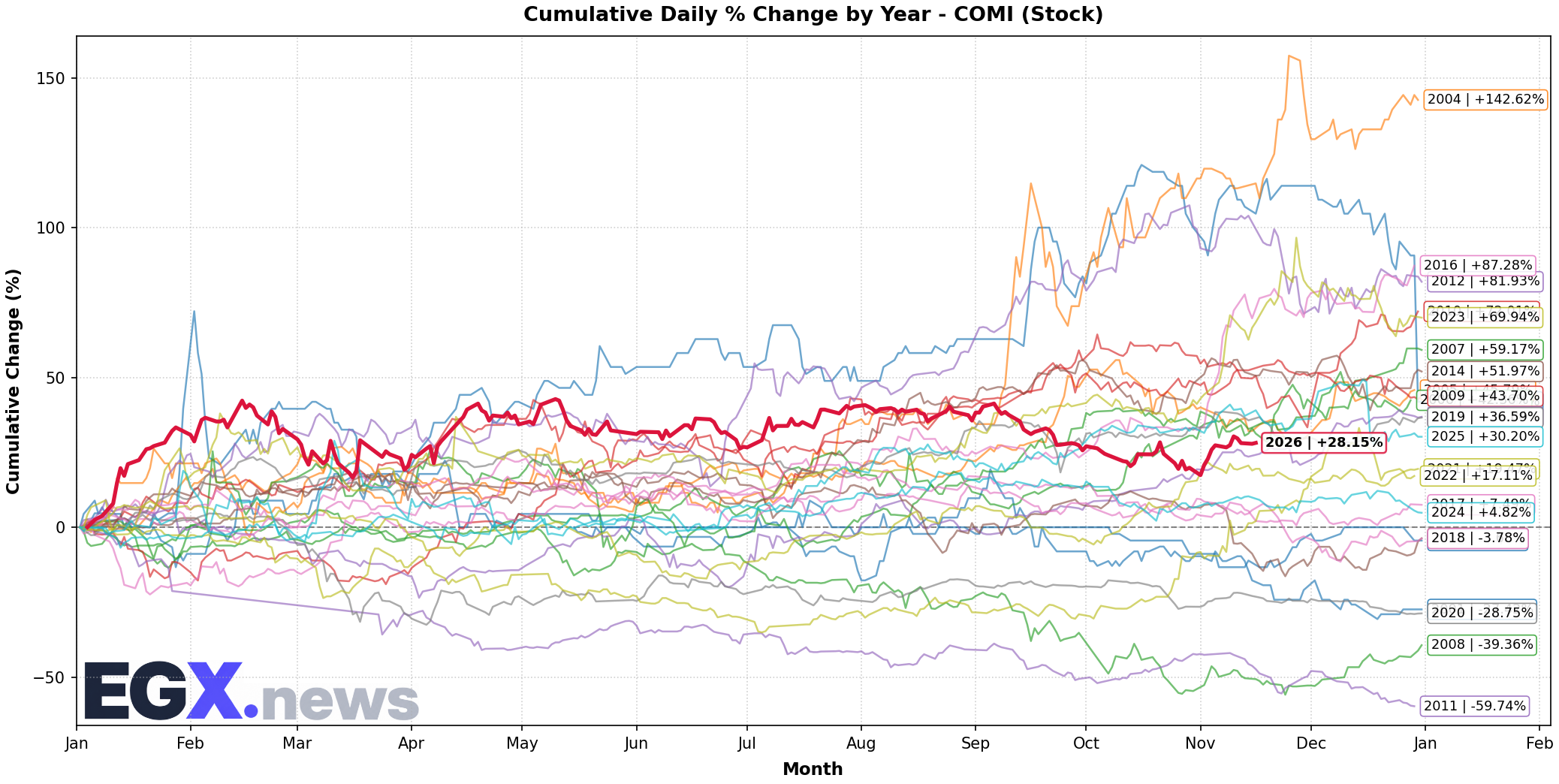
The banking sector continued its role as a relative safe haven within the Egyptian portfolio, backed by strong Q3 2026 earnings. Commercial International Bank (COMI) led the scene with an 18% year-on-year growth in consolidated net profit, driven by higher net interest income and improved asset quality. This robust performance provided price support for the stock, limiting main index losses, and attracted local institutional flows seeking to deploy liquidity in assets with positive real returns.
| Financial Metric | Commercial International Bank (COMI) | Banking Sector (Average) |
|---|---|---|
| Net Profit Growth (YoY) | 18% | 15% |
| Return on Equity (ROE) | 22.5% | 20.1% |
| Non-Performing Loans Ratio | 3.2% | 4.1% |
#### Telecommunications Sector: Global Index Catalyst
The inclusion of Telecom Egypt in the MSCI Emerging Markets Standard Index during its semi-annual review served as a strong fundamental catalyst for the stock. This inclusion crowns a 43.7% profit growth during the first nine months of the year, driven by rising infrastructure and data services revenues. Analysts anticipate passive flows estimated at $150-200 million on the stock in the coming weeks, providing price support and high liquidity.
#### Sectors Under Pressure: Real Estate and Basic Materials
Conversely, the real estate sector witnessed sharp selling pressure following Palm Hills' announcement of a net profit decline, and the collapse of Ceramica Remas profits by 81.9% due to rising energy and raw material costs and weak local purchasing power. These negative results revived concerns over rising financing costs and their direct impact on the profitability of highly leveraged companies.

Second: Macro Environment and Liquidity.. A Complex Equation
#### Exchange Rate Stability and Remittances
On the macro level, the Egyptian pound showed notable stability in official banking channels, supported by strong remittance inflows from Egyptians abroad recording $13 billion in just three months. This direct foreign cash flow acts as a shock absorber against external pressures, reducing dollar demand pressures in the parallel market, granting the Central Bank flexibility in managing its foreign reserves.
#### Foreign Currency Auctions and Debt Instruments
The Central Bank of Egypt continues to manage local liquidity cautiously through open market operations and periodic foreign currency auctions. Current exchange rate stability reduces the likelihood of a sudden pound devaluation, yet simultaneously keeps yields on treasury bills and government bonds at elevated levels (exceeding 27% for one-year tenor), making fixed income instruments a fierce competitor to equities in attracting local institutional liquidity.
#### Federal Reserve Scenario: The Biggest External Risk
Global developments remain the most dangerous variable. Deutsche Bank expectations of a 75 basis point Fed rate hike at the upcoming December meeting, driven by sticky US inflation data, represent a "nightmare scenario" for emerging markets. Should this scenario materialize, the yield differential between the dollar and the pound would widen, potentially pressuring foreign portfolio flows into government debt instruments, and negatively reflecting on equity indices through the foreign exit channel.
Third: Winning Sectors.. Energy and Healthcare Lead
| Sector | Key Driver | Relative Performance |
|---|---|---|
| Energy | Drilling agreement with Halliburton, new gas production from Mediterranean | Strong Positive |
| Healthcare | Capital expansions at Nile Pharma and Memphis Pharma | Positive |
| Banks | Profit growth, asset quality, positive real return | Neutral to Positive |
| Real Estate | Profit decline, high leverage, weak sales | Negative |
| Basic Materials | Profit collapse (Ceramica), high energy costs | Negative |
Fourth: Technical Analysis and Critical Watch Levels
#### EGX30
- First Resistance Level: 30,800 points (50-day moving average).
- First Support Level: 30,000 points (strong psychological and technical barrier).
- Critical Support Level: 29,600 points (November low/200-day moving average). A break below this level opens the door toward 28,500 points.
- Technical Indicators: Relative Strength Index (RSI) at 48, indicating neutral momentum leaning bearish. Potential negative MACD crossover if close below 30,200 points.
#### EGX70 EWI
- Trading in a tight sideways range between 8,200 and 8,500 points.
- Low liquidity on small caps makes the index prone to sharp swings on limited volumes.
- A break above 8,500 points with daily trading volume exceeding EGP 1.5 billion is required to confirm a sustainable uptrend.
Fifth: Upcoming Catalysts.. Roadmap for Coming Sessions
1. Federal Reserve Meeting Outcome (December 2026): The most important global event. Any signal for a rate hike will reprice risk globally.
2. Q4 Earnings Season: Particularly major banks (Ahli, Misr, Cairo) and real estate/cement sectors. These results will set the tone for speculative direction in Q1 2027.
3. MSCI Index Rebalancing: Execution of flows on Telecom Egypt and other relatively weighted stocks.
4. Central Bank Foreign Currency Auctions: Any change in allocation mechanism or price will send strong signals to the market regarding exchange rate targets.
Conclusion and Strategic Recommendation
The Egyptian Exchange currently operates within a defensive selective regime par excellence. The Market Health Index at 55.7 out of 100 confirms the environment is not conducive to broad speculation or margin trading.
Optimal Strategy for Current Phase:
- Concentrate liquidity on blue-chip stocks with strong fundamentals and confirmed institutional flows (major banks, Telecom Egypt, producing energy companies).
- Avoid highly leveraged cyclical sectors (real estate, certain basic materials) until clarity on global and local interest rate trajectories emerges.
- Employ strict stop-loss orders upon breach of the aforementioned technical support levels.
- Monitor trading volumes as a primary indicator of the validity of any upcoming price action; price movement without liquidity in the Egyptian market is often a liquidity trap.
The next session will be a real test of the index's ability to hold above the 30,000-point barrier amid the absence of new local catalysts and the dominance of global negativity.
Live Egyptian Equities Coverage
Track real-time quotes, order book market depth, and quantitative technical analytics for all 299 listed companies.
Open Real-Time Market Terminal →