


Morning & Opening Report: Egyptian Exchange at a Crossroads Between Global Headwinds and Local Structural Resilience - 12 November 2026
Executive Summary
The Egyptian Stock Exchange commenced the November 12, 2026 session in a phase of selective accumulation, with the Technical Health Index recording a reading of 59.8 points, reflecting a market standing at a critical juncture. The landscape is dominated by compound external risks, notably the global AI sector leadership crisis and its repercussions on risk-off sentiment, alongside US inflation stabilizing above expectations, reinforcing bets on imminent monetary tightening by the Federal Reserve. Conversely, the domestic narrative presents a constructive picture supported by historic foreign reserves, quarterly remittance inflows of $13 billion, a 94% surge in Suez Canal revenues, innovative fiscal measures such as Red Sea land allocation to reduce debt burdens, and confirmation of an 80% private sector contribution to GDP. Technically, the main index holds above the 52,500-point barrier with clear signals of institutional absorption at support zones; however, weak EGX70 performance and narrow market leadership impose tactical caution.
---
Global Macro Landscape: A Perfect Storm Strikes Risk Appetite
#### The Nvidia Crisis and the Collapse of the AI Narrative
Global markets are reeling from reports that Nvidia's board is studying the removal of CEO Jensen Huang, sending the stock down over 8% in after-hours trading, wiping out nearly $430 billion in market value over two sessions. This development is not merely a single-company event; it represents a fundamental blow to the technology growth narrative that has led global markets for the past two years. The decline in CoreWeave shares despite earnings jumps, and downgrades on the main stock, raise fears of a comprehensive repricing of the semiconductor and AI infrastructure sectors, pressuring global portfolio flows toward emerging markets.
#### US Inflation and the Dollar: A Double Blow to Emerging Markets
US October inflation data showed a monthly reading of 0.4%, exceeding analyst expectations, reigniting expectations of a Federal Reserve rate hike at the upcoming December and January meetings. In response, the Dollar Index jumped to a 19-month high, while gold fell below the $4,000 barrier and Bitcoin dropped below $74,000. This "strong dollar, high rates" environment represents the most hostile backdrop for hot money flows into emerging market debt and equity instruments, including Egypt.

---
Domestic Fundamental Drivers: External and Fiscal Balance Resilience
#### External Account: Fortresses of Hard Currency
On the domestic front, structural strength indicators stand out clearly:
- Foreign Reserves: Continue to record unprecedented historic levels, providing comfortable cover for over eight months of imports.
- Egyptian Expatriate Remittances: Recorded a qualitative leap of $13 billion in just three months, reflecting the diaspora's confidence in exchange rate stability and Central Bank policies.
- Suez Canal Revenues: Surged 94% year-on-year, driven by global trade route shifts and higher transit fees, remaining the economy's most critical dollar engine.
- Public Debt Management: Cabinet approval of Red Sea land allocation to reduce public debt, and a review of 2030 debt targets, represents an innovative approach to sovereign balance sheet management away from traditional borrowing.
#### International Partnerships and Development Finance
Economic relations are witnessing intense diplomatic momentum:
- Investment and Planning Ministers' talks with the US side to strengthen economic ties.
- Efforts to mobilize US investments and capital via partnership with the Development Finance Corporation (DFC).
- Deepening economic partnership with Germany through investment and trade.
- Cabinet approval of the second phase of the World Bank's Budget Support Program.
- Suez Canal Economic Zone exploring financing partnerships with Shanghai Pudong Development Bank.
#### Private Sector Dominance: The Awaited Structural Transformation
The Planning Minister's statement that the private sector contributes 80% of GDP is not merely a statistic; it is the culmination of the government's IPO program and business climate reforms, confirming that the future growth engine is now privately owned, enhancing the market's appeal to the long-term strategic investor.

---
Technical Analysis: Primary Resilience and Parallel Weakness
#### EGX30: Fierce Defense of the 52,500 Zone
The main index holds above the psychological and structural support level of 52,500 points, with clear lower wicks on daily candles over the past three sessions, indicating intervention by strong buyers (institutions) absorbing selling pressure. The Relative Strength Index (RSI) on the daily timeframe shows a slight positive divergence, while the 50-day moving average remains above the 200-day average, preserving the long-term uptrend. A break above the 53,000 resistance on volume exceeding EGP 1 billion would confirm resumption of the upward wave toward 54,500.
#### EGX70: Warning Signals on Narrow Leadership
In contrast, the EGX70 continues its decline to test the 8,500 level, recording a drop exceeding 5% over the past month. The Advance/Decline Ratio stands at 0.78, confirming that the current advance is led by a limited number of heavy large-cap stocks while the broad base of small and mid-cap stocks lacks momentum. This divergence between the two indices is a classic sign of a maturing uptrend or the onset of a prolonged sideways correction.
#### Market Maker Activity Monitoring: Liquidity Traps on Specific Stocks
Monitoring systems flag "Market Maker Trap" alerts showing sharp lower wicks on stocks: AIHC, FTNS, ACAMD, DTPP, AIDC. These technical patterns indicate deliberate institutional accumulation at technical support levels, where speculators' stop-loss orders are triggered before price reversal. This behavior supports the hypothesis of "Smart Money" accumulation in specific sectors (pharmaceuticals, chemicals, building materials) away from general market noise.
---
Liquidity and Institutional Flows: Between Hot Money and Strategic Investors
| Liquidity Indicator | Current Reading | Assessment | Implications |
|---|---|---|---|
| Foreign Flows (Net) | Inflow $1.6B (last 4 weeks) | Volatile / Sensitive to global risk | Prone to rapid reversal on Fed surprise or geopolitical escalation |
| Arab Flows | Moderate net buyer | Stable | Supports blue-chips and defensive sectors |
| Local Institutional Flows | Strong buyer on dips | Very Positive | Market backbone, absorbs supply at supports |
| Daily Volume (10-session avg) | EGP 2.8B | Below historical average | Reflects speculator caution and catalyst anticipation |
| EGX30 Share of Total Volume | 85% | High | Confirms narrow leadership and liquidity concentration in large-caps |
Contextual Analysis: The market is currently pricing a "global soft landing" scenario. Any deviation toward aggressive Fed tightening, or geopolitical escalation in the Red Sea or Strait of Hormuz threatening Suez Canal revenues, would instantly shift the market regime from "selective accumulation" to "purely defensive" with hot money flight.
---
Sectoral Focus: Banks and Financial Services at the Eye of the Storm
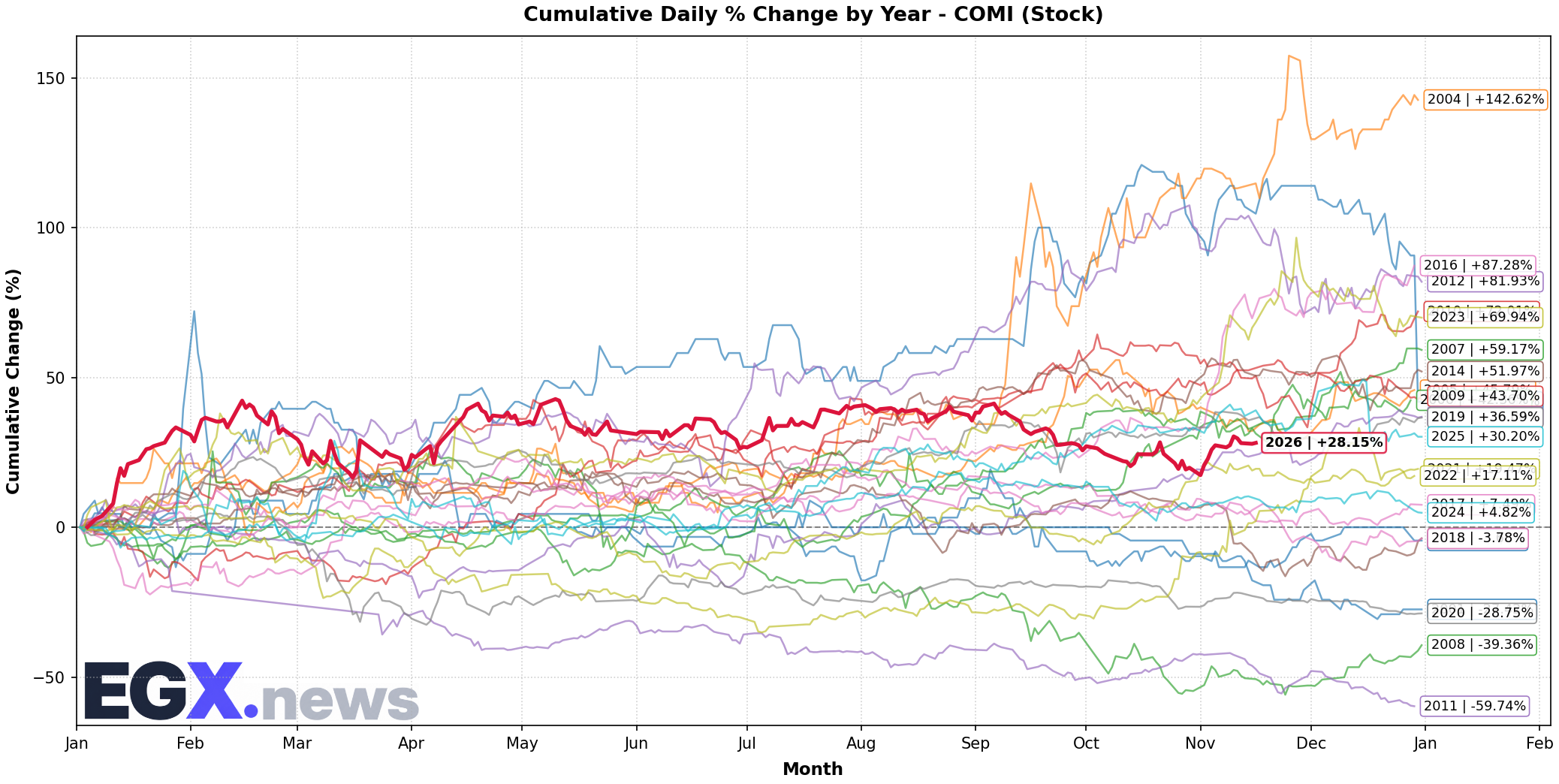
The Banking and Financial Services sector remains the primary axis for portfolio flows, with Commercial International Bank (COMI) serving as the key benchmark for institutional risk appetite.
- Technically: The stock holds above the 50-day average, forming a "Cup and Handle" pattern on the weekly chart targeting new highs upon a break above the EGP 105 resistance on strong volume.
- Fundamentally: The sector benefits from expanding Net Interest Margins (NIM) in a high local rate environment, gradually improving asset quality with receding FX risks, and loan portfolio growth driven by the private sector.
- Risks: Government bond portfolio exposure to repricing risk (Mark-to-Market) should global yields continue rising, and the impact of a global economic slowdown on trade finance activities.
---
Key Levels and Expected Session Scenarios
#### EGX30
| Level | Type | Description |
|---|---|---|
| 53,200 | Strong Resistance | Break on volume > 1.2B opens target 54,500 |
| 52,800 | Medium Resistance | Short-term short-selling level |
| 52,500 | Pivotal Support / Session Low | Break closes accumulation window, targets 51,800 |
| 52,200 | Strong Support / Institutional Stop-Loss | Zone of concentrated institutional buy orders |
#### COMI Stock
| Level | Type | Description |
|---|---|---|
| 105.00 | Psychological & Technical Resistance | Break confirms Cup and Handle pattern |
| 102.50 | Medium Support | 20-day moving average |
| 100.00 | Strong Support / Previous Low | Main accumulation zone for funds |
---
Upcoming Catalysts: Weekly Roadmap
1. US CPI Data & Fed Minutes: Primary driver for the dollar and emerging market flows.
2. Egypt November Inflation Reading & Monetary Policy Reaction: Upcoming MPC meeting to determine local borrowing cost trajectory.
3. Q3 2026 Earnings Season: Commencement of bank, telecom, and consumer sector disclosures; the fundamental driver for repricing.
4. IMF Program Review: Any signals on timing of next tranche or FX flexibility.
5. Monthly Suez Canal Revenue Trends: Monitoring impact of Houthi attacks on transit volumes.
6. Global Tech Sector Stability: Any stabilization in Nvidia shares would restore global risk appetite.
---
Conclusion and Strategic Recommendation
The Egyptian Exchange stands on fundamentally solid ground today but remains exposed to fierce external winds. Optimal strategy for the current session and week:
- For Long-Term Institutional Investors: Exploit any price weakness toward support levels (52,500 for index, EGP 100 for COMI) to increase positions in high-quality stocks with sustainable cash yields and exposure to the private sector growth story.
- For Medium-Term Traders: Strict adherence to stop-loss orders below pivotal supports mentioned, and avoidance of low-liquidity EGX70 stocks until the advance/decline ratio improves.
- Risk Management: Reduce margin exposure to a minimum, raise cash allocations in portfolios to 20-25% as a reserve for panic-buying opportunities, and avoid betting on resistance breaks before volume confirmation.
The Egyptian market is no longer a "hostage" to hot money flows as in the past, thanks to external balance resilience and private sector dominance, but it remains "sensitive" to global risk pricing. Patience and discipline are the most valuable currency in the current phase.
Live Egyptian Equities Coverage
Track real-time quotes, order book market depth, and quantitative technical analytics for all 299 listed companies.
Open Real-Time Market Terminal →