


Morning and Opening Report: Egyptian Exchange in Selective Consolidation Phase Amid Global Headwinds and Local Structural Drivers - 15 November 2026
Executive Summary
The Egyptian Exchange commences trading on 15 November 2026 in a "selective consolidation" posture, with the benchmark EGX30 index holding above the psychological and technical support barrier at 52,500 points. This resilience is underpinned by the semi-annual review of the MSCI Emerging Markets indices, which added Egyptian Telecommunications Company (ETEL) to the standard index—a key catalyst for incoming institutional liquidity. However, this domestic momentum faces acute external tests, most notably escalating expectations of a 50-basis-point rate hike by the US Federal Reserve at its December meeting, driven by US inflation data exceeding forecasts. This has pushed 10-year US Treasury yields higher and strengthened the dollar globally, threatening a reversal of recent emerging market portfolio flows.

I. Macro Landscape, Interest Rates, Inflation, and Exchange Rate
#### 1. Global Monetary Environment: Risks of a Sharp Pivot
Recent US economic developments point to persistent price pressures, with core inflation readings coming in above the central bank's targets, reviving the "50-basis-point shock" scenario for the 16-17 December meeting. This scenario carries direct implications for emerging markets through two channels:
- Yield Channel: Rising risk-free returns in the United States diminish the relative yield appeal of Egyptian pound-denominated assets.
- Dollar Channel: Global dollar strength pressures emerging market currencies and increases the cost of servicing external debt.
#### 2. Local Currency Dynamics and Reserves
Domestically, the Egyptian pound has shown notable resilience, depreciating approximately three pounds from its annual peak against the dollar, supported by robust structural factors:
- Record Foreign Reserves: The Central Bank's hard currency stockpile provides a comfortable cover for stability.
- Strong Remittance Flows: Quarterly remittances recorded approximately $13 billion, bolstering the banking system's net foreign assets.
- Divestment Program and Debt Management: Cabinet approval of the second phase of the World Bank's budget support program, and allocation of Red Sea lands to alleviate public debt, are steps that enhance international institutional confidence and reduce future liquidity risks.

II. Liquidity Analysis, Market Breadth, and Technical Indicators
#### 1. Technical Health and Market Breadth Indicators
According to the composite "Health Index" reading, the market settles at 58.8 points, reflecting a healthy consolidation phase following the prior rally. Market breadth shows a slightly positive tilt, with 47.1% of stocks advancing versus 14.5% declining. However, the advance-decline ratio of 0.73 reveals latent cyclical selling pressures beneath the surface of relative calm, warranting caution against chasing peaks without volume confirmation.
#### 2. Technical Deception Signals and Liquidity Distribution
Advanced technical analysis models (OLFI, CIEB, EGAS, PRMH, MOIN, AIHC, FTNS) detect "Technical Deception" signals manifested as aggressive distribution at resistance levels across multiple sectors. The appearance of pivotal stocks such as CIEB and OLFI simultaneously in both "actionable buy lists" and "deception lists" confirms institutional hesitation and underscores the necessity of awaiting resolution candles before establishing new high-risk positions.
#### 3. High Conviction Watchlist
Given the intersection of index catalysts (MSCI Inclusion) and strong fundamentals, the following names emerge as priorities for strategic portfolios:
- Egyptian Telecommunications (ETEL): Direct beneficiary of index inclusion, mandatory passive inflows, and unique infrastructure assets.
- Commercial International Bank (COMI): Absolute index heavyweight, distinguished banking asset quality, and beneficiary of the future local rate-cutting cycle.
- Hermes Holding (HRHO): Diversified exposure to non-banking financial services, strong asset management, and high stock liquidity.
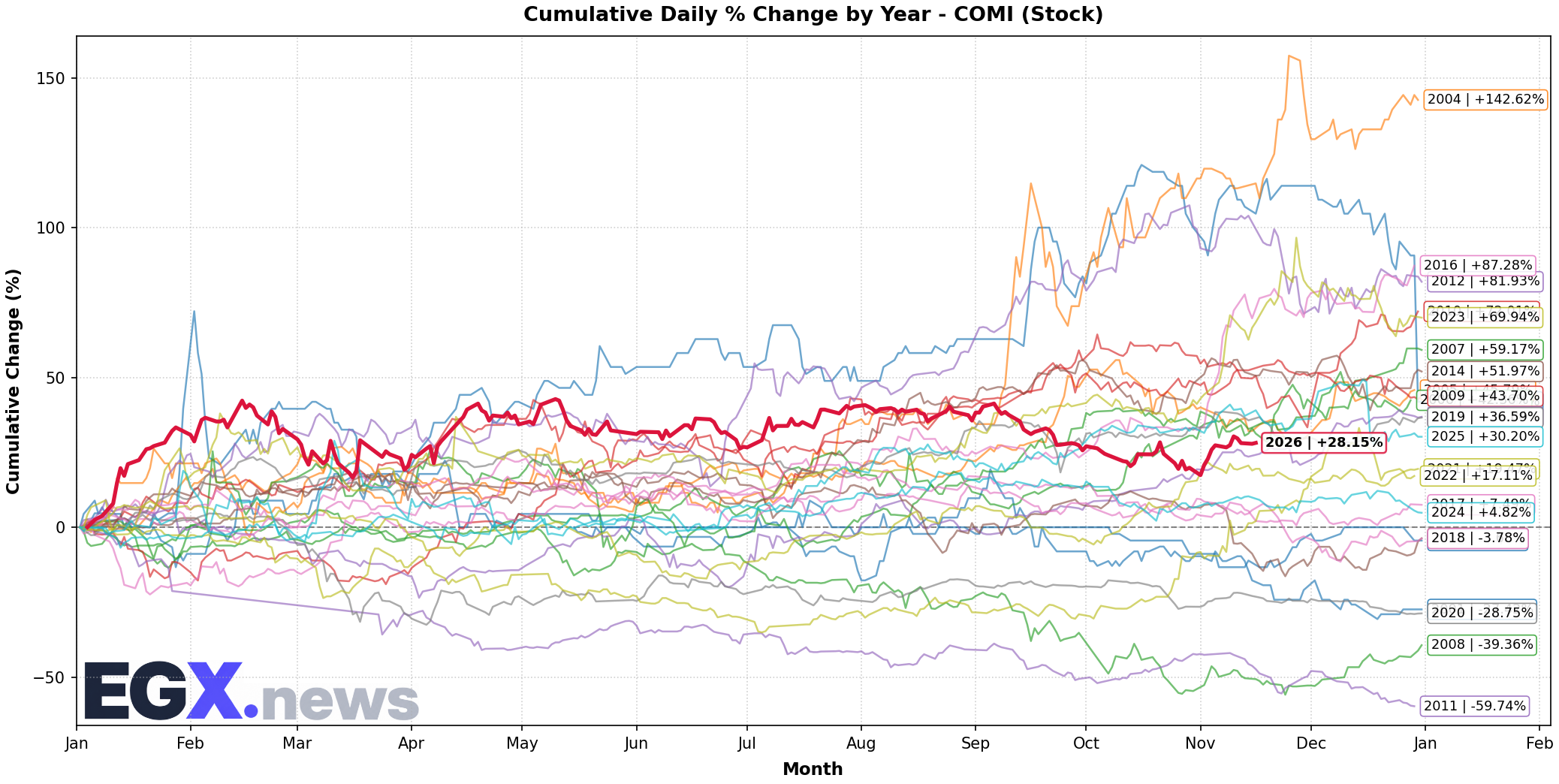
III. Sectors and Stocks with Differential Momentum
| Sector | Core Driver | Stocks to Watch | Risk Level |
|---|---|---|---|
| Telecommunications & IT | MSCI Inclusion, Data Growth, Tower Assets | ETEL | Low - Medium |
| Banks & Financial Services | Asset Quality, Net Interest Margins, Index Weight | COMI, CIB (not listed but fundamental) | Low |
| Real Estate & Housing | Genuine Demand, Inflation Hedge, Govt Offerings | MOLT, MASR, PHDC | Medium |
| Consumer Staples | Household Spending Strength, Flexible Pricing | ORWE, COIL | Medium - High |
| Fertilizers & Chemicals | Global Commodity Cycles, Subsidized Gas | (Currently Under Pressure) | High |
Note: The fertilizer sector exhibited price bleeding over the past week, impacted by global commodity price correction and dollar strength, necessitating a wait for export margin stabilization.
IV. Critical Catalysts for Coming Days and Weeks (Event Calendar)
| Date / Period | Event | Expected Market Impact |
|---|---|---|
| November / December | US Inflation Data Releases (CPI/PCE) | Primary determinant of Fed 50bp hike probability. |
| 16 - 17 December | FOMC Meeting | Highest global risk event; a 50bp hike decision could pressure emerging market portfolio flows. |
| December | IMF Executive Board Approval of Fourth Review | Strong positive structural catalyst; unlocks next financing tranche and supports credit rating. |
| Immediate | EGX30 Break Above 53,500 or Break Below 51,800 | Technical confirmation of next direction (rally toward 55k vs deep correction). |
| Q3 2026 Earnings Season | Bank, Telecom, Real Estate Earnings | Fundamental driver for stock selectivity; focus on Net Interest Income growth and Operating Profits. |
| Government Divestment Program | Water, Energy, Bank Stake Offerings | Market deepening, attraction of strategic foreign investors, debt burden alleviation. |
V. Recommended Strategy for Upcoming Sessions
Based on current data, the Strategic Analysis Unit at "EGX News" adopts the following guidelines for institutional investors and high-net-worth individuals:
1. Index Quality Bias: Build or add to positions in (ETEL, COMI, HRHO) as primary beneficiaries of passive fund flows and active liquidity seeking relative safe havens within the market.
2. Avoid Early Breakout Chasing (No Chasing Breakouts): Refrain from buying on breaks of key resistances (53,500 for the index) until two consecutive sessions close above it with volume exceeding the monthly average, to avoid the "technical deception" traps identified.
3. Currency and External Yield Risk Management: Monitor the US 10-Year Yield (US10Y) and USD/EGP exchange rate as primary gauges of external risk (Beta Risk). Any yield rise above 4.5% alongside a stable local dollar warrants trimming high-beta positions.
4. Selectivity in Defensive and Cyclical Sectors: Prefer real estate with contracted cash flows (MOLT, MASR) and consumer staples (ORWE) over short-term speculation in commodity-sensitive cyclical sectors (fertilizers, steel).
5. Leverage the Divestment Program: Monitor subscription opportunities in upcoming government offerings (particularly energy and water) as primary market instruments with attractive risk-adjusted returns.
Conclusion
Today's session represents a pivotal juncture; the main index stands on solid ground technically and fundamentally, backed by unprecedented local support (reserves, remittances, reforms, MSCI inclusion). Yet, the ceiling is defined by uncontrollable external variables (Fed decisions, geopolitics, global tech volatility). Discipline in execution, adherence to capital management rules, and focus on "companies, not stocks" remains the sole compass for navigating this selective volatility phase toward genuine value opportunities.
---
Live Egyptian Equities Coverage
Track real-time quotes, order book market depth, and quantitative technical analytics for all 299 listed companies.
Open Real-Time Market Terminal →