


Morning and Opening Report: Egyptian Exchange in Crosshairs of Global Volatility.. Selective Defensive Stance Awaiting Local Catalysts - 18 November 2026
Executive Summary
The Egyptian Exchange commences trading on Wednesday, 18 November 2026, in an environment dominated by extreme caution, with the Market Health Index at 53.9 points confirming the selective defensive character governing investor movements. Major indices have shed cumulative momentum exceeding EGP 56.8 billion, driven by sustained institutional outflows, while global variables exert pressure—led by technology sector volatility spearheaded by Nvidia, uncertainty surrounding the US interest rate trajectory, and declining commodity prices, notably gold which has lost 32% from its all-time peak. Domestically, the Egyptian pound's stability below the EGP 54/USD threshold, the approval of a wage hike package effective January 2027, and the commencement of production from new natural gas fields provide fundamental support to economic fundamentals. However, persistent institutional selling and capital withdrawal from the real estate sector keep a short-term downtrend the most probable scenario for both the EGX30 and EGX70 indices, with selective opportunities remaining present in the telecommunications and banking sectors.
---
I. Global Macro Landscape and Impact on Risk Appetite
1. The Federal Reserve and AI: A New Variable in the Rate Equation
Federal Reserve Chair remarks suggesting that accelerated AI development may compel the central bank to cut interest rates in the future have sparked widespread market debate. This comes as US Treasury yields have retreated and the dollar has pulled back from year-highs, opening the door to speculation about an earlier-than-expected monetary policy pivot. Nevertheless, the upcoming FOMC minutes remain the primary driver of global liquidity trends, amid three scenarios outlined by the Fed for AI's future impact on productivity and inflation.
2. Technology Sector: Nvidia Between "Moment of Truth" and "Reckoning"
Nvidia dominates the global stage with quarterly revenue surging to $115 billion, exceeding expectations in its first results post-Jensen Huang's announced departure. Despite strong figures, concerns over leadership transition, SEC investigation, and the board's refusal to reinstate Huang cast shadows over investor confidence. The Fear Index rose 20%, while the Dow Jones suffered sharp losses of 900 points in a prior session, with $45 billion trapped in losing S&P 500 options contracts. This acute volatility in the world's largest market engine reflects negatively on foreign portfolio flows into emerging markets, including Egypt.
3. Commodities and Currencies: Gold Plunges, Dollar Retreats
The yellow metal has shed 32% of its value to reach its lowest level in over a year, with Goldman Sachs indicating it will not reclaim its peak before two years. This decline reduces the appeal of traditional safe havens, yet simultaneously eases imported inflation pressures on developing economies. The resumption of Iraqi oil flows via Turkey and the Eurozone's resilience to energy shocks contribute to relative energy price stability—a positive factor for Egypt's balance of payments.
---
II. Domestic Fundamentals.. Monetary Stability and Structural Reforms
1. Exchange Rate and Monetary Liquidity
The Egyptian pound continues to trade in a narrow range below the EGP 54/USD level, supported by anticipated foreign direct investment flows from the expansion of electronic contracting to 150 countries, and upcoming government offerings—most notably the Egyptian Life Insurance Company IPO in December 2026. This stability grants the Central Bank of Egypt room to maintain positive real interest rates, a prerequisite for attracting financial investments in government debt instruments.
2. Fiscal and Social Stimuli
The wage hike package scheduled for January 2027 represents a strong catalyst for domestic demand and consumption, supporting revenues of listed companies with high domestic exposure (consumer, banking, telecommunications). Additionally, the allocation of Red Sea lands to reduce public debt and the revision of 2030 debt targets reflect government seriousness in public finance management.
3. Energy Sector: Strategic Gains
The commencement of natural gas production from new fields enhances Egypt's capacity to achieve self-sufficiency and export surplus, supporting the balance of payments, reducing the energy import bill, and reflecting positively on petrochemical and energy sector equities.
---
III. Technical Analysis and Liquidity for the Egyptian Market
1. EGX30 Index: Defensive at Critical Support

The main index trades in a sideways range with a downward bias, repeatedly testing the psychologically and technically critical support level at 51,400 points. A daily close below this level on high volume opens the path toward 49,500 points. Technical indicators (RSI, MACD) show oversold conditions on the daily timeframe, which may trigger a limited technical pullback toward 53,000–53,500 points, where selling into strength remains the optimal strategy for speculators, while medium-term investors should await clear breakout signals above the 54,000-point resistance accompanied by institutional inflows.
2. EGX70 Index: Selling Pressure on Small and Mid-Caps

The small and mid-cap index continues its relatively weak performance, affected by local and foreign fund outflows from low-liquidity names. A break of the current primary support deepens losses toward new historic lows. Extreme selectivity is mandatory here, focusing on companies with strong fundamentals and attractive cash dividends.
3. Commercial International Bank (COMI): Relative Haven in Banking Sector
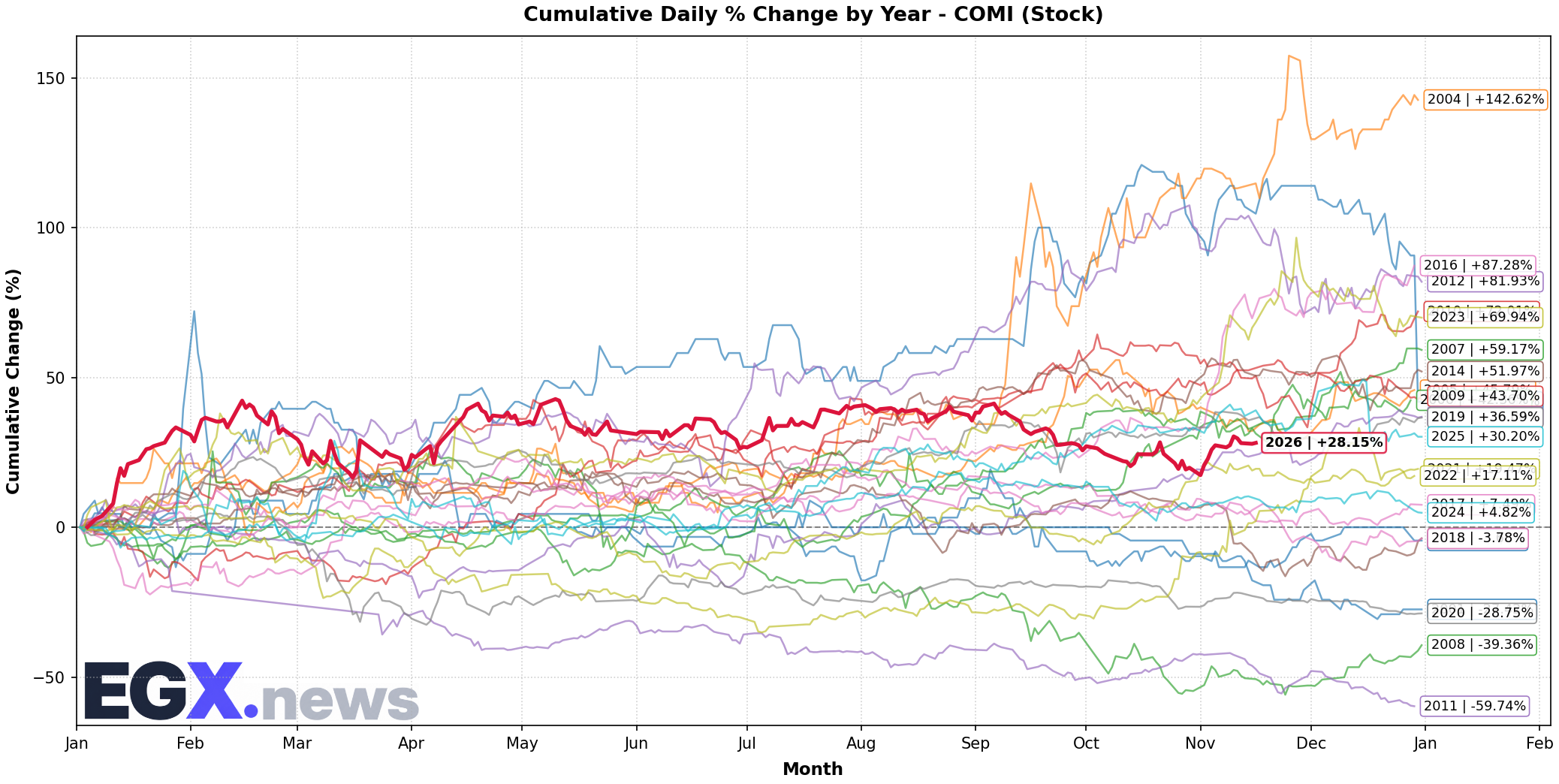
CIB "COMI" remains the true benchmark for banking sector health and foreign liquidity. The stock holds above its 50-day moving average, supported by strong earnings expectations benefiting from rising net interest margins and loan portfolio growth. Any incoming foreign flows to the market will start with this stock, making it an early indicator for overall market direction change. Upside technical target at EGP 95, critical support at EGP 85.
---
IV. Sectoral Outlook.. Opportunities and Risks
| Sector | Rating | Fundamental Rationale | Key Risks |
|---|---|---|---|
| Banks & Financial Services | Positive / Neutral | Rising net interest margins, credit growth, wage package supports deposits and loans, attractive valuations (P/B < 1 for some names). | Asset quality risks in real estate sector, potential local liquidity pressures. |
| Telecommunications & IT | Positive | Defensive nature, stable hard-currency cash flows, data and digital services growth, attractive cash dividends. | Regulatory pricing pressures, increasing competition. |
| Real Estate | Negative | Sustained institutional capital withdrawal, slowing sales, high financing costs, oversupply concerns. | Sudden improvement in foreign liquidity, government mortgage stimulus initiatives. |
| Energy & Petrochemicals | Neutral / Positive | New gas production, stable oil prices, export expansion plans. | Global commodity volatility, delays in foreign partner receivables. |
| Consumer Discretionary | Neutral | Wage package supports future demand, but current purchasing power remains pressured by accumulated inflation. | Declining consumer confidence, rising import costs. |
---
V. Upcoming Catalysts and Risk Factors (Next Week)
Positive Catalysts
1. Egyptian Life Insurance Company Listing (December 2026): Major liquidity event expected to attract local and foreign portfolios.
2. Electronic Contracting Expansion (150 Countries): Opens door to new indirect foreign investment flows.
3. US PCE Inflation Data & Fed Minutes: Any signals of rate hike pause or cuts would restore liquidity to emerging markets.
Negative Risk Factors
1. Persistent Local Institutional Selling: Local mutual funds face redemptions, pressuring domestic liquidity.
2. Escalation of Global Tech Crisis: Any fresh collapse in "Magnificent Seven" stocks drains global risk appetite.
3. Regional Geopolitical Escalation: Direct impact on tourism, FDI flows, and exchange rate.
---
VI. Proposed Trading Plan for the Session
1. Speculators (Intraday / Swing): Focus on liquid blue-chips (banks, telecom) near technical support levels. Use strict stop-loss orders (1.5%–2%). Sell into any weak-volume technical bounce.
2. Medium and Long-Term Investors: Build gradual positions in high-quality names in banking and telecommunications sectors, exploiting any fundamentally unjustified price weakness. Await resolution of the 51,400-point level on the EGX30 before deploying significant capital.
3. Risk Management: Reduce exposure to real estate and illiquid speculative stocks. Raise cash allocation in portfolios to 20%–25% to capitalize on upcoming offerings and sharp corrections.
---
Conclusion
The Egyptian Exchange is undergoing a classic "stock-picking" phase, where the market punishes companies with weak fundamentals and rewards strong ones—but at a glacial pace imposed by a liquidity-starved environment. Exchange rate stability and structural reforms provide a "solid floor" preventing sharp crashes, while the absence of immediate catalysts for institutional liquidity keeps the "ceiling low." Today's session is likely to range-bound, awaiting an external catalyst (Fed/oil) or domestic one (insurance IPO/inflation data). Patience and selectivity are the watchwords of this phase.
---
Disclaimer: This report expresses an analytical opinion based on data from the official EGX.news platform and does not constitute a buy or sell recommendation. Investment decisions are the sole responsibility of the investor.
Live Egyptian Equities Coverage
Track real-time quotes, order book market depth, and quantitative technical analytics for all 299 listed companies.
Open Real-Time Market Terminal →