


Morning and Opening Report: Egyptian Exchange Tests Pivotal Supports Amid Global Risk-Off Storm - 22 November 2026
Morning and Opening Report: Egyptian Exchange Tests Pivotal Supports Amid Global Risk-Off Storm
Executive Summary
The Egyptian Exchange opens trading for the Sunday session of 22 November 2026 under the weight of an unprecedented global selling wave that has swept all risk assets, where the "EGX 30" index lost about 2.5 percent of its market value during the past week, recording capital losses approaching 105 billion pounds, testing the pivotal technical support zone at the level of 51,500 points. These moves coincide with a historic collapse in the global artificial intelligence sector and the besieging of technology assets, and the escalation of monetary tightening rhetoric from the US Federal Reserve, which pushed the US Dollar Index to its highest levels since March 2025 and plunged precious metals into their worst week in eight months. However, the fundamental pillars of the Egyptian economy remain steadfast, supported by the ongoing implementation of the International Monetary Fund program, the accelerating pace of foreign direct investment, and gross domestic product growth of 4.9 percent in the first quarter of the current fiscal year, in addition to the successful offering of Banque du Caire and the imminent offering of Misr Life Insurance Company. The report adopts a "Market Caution / Defensive Selectivity" scenario (Health Index 50.6) with a focus on sectors with strong balance sheets and rewarding dividend returns.
Global Macroeconomic Scene: Tightening Storm and Risk Aversion
#### Hawkish Federal Reserve Dominance and Dollar Path
The US Dollar Index continues its rise for the fourth consecutive week, stabilizing at its highest levels since March 2025, driven by Federal Reserve officials' statements that rule out cutting interest rates in the near term, but hint at the possibility of raising them at the December meeting. This path puts strong pressure on capital flows toward emerging markets and imposes a high opportunity cost on holding non-dollar assets.
#### AI Bubble Collapse and Contagion Impact
Global markets witnessed the erasure of more than four trillion dollars of the artificial intelligence sector's market value, led by the collapse of "Nvidia" stock by about 23 percent and "Anthropic" stock by about 28 percent from its peak, amid accounting scandals and fraud. This collapse not only erased the "Nasdaq" index's gains for 2026, but also launched a severe risk-off wave that extended to include all growth and technology assets, and pressured investors' appetite toward emerging market stocks with high beta.
#### Commodities and Cryptocurrencies: Shaken Safe Havens
Gold recorded its worst weekly performance in eight months, losing $343 per ounce, breaking the $3,500 barrier and threatening to extend toward $3,200. Silver also plummeted 15 percent to its lowest level since September 2025. In parallel, "Bitcoin" collapsed to its lowest level in two years, approaching $31,500, negating its safe-haven attribute in an environment of US dollar liquidity tightening.
Local Market Performance and Technical Analysis: Testing Support at 51,500 Points
#### "EGX 30" Index: Critical Sideways Range

Technical Analysis: The index closed last week's trading at the level of 51,550 points, down 2.5 percent weekly. The index is currently testing the medium-term uptrend line and the 50-day moving average converging at the zone of 51,500 - 51,600 points.
- Breakdown Scenario: Daily closing below 51,400 points with trading volume exceeding one billion pounds opens the door toward the next support at 50,800 points (61.8 percent Fibonacci level of the last upward wave).
- Rebound Scenario: Holding above 51,500 points with the appearance of real trading volumes and the return of institutional buyers (especially in banks) targets retesting the psychological resistance at 53,000 points.
- Technical Indicators: The Relative Strength Index (RSI) at 38 points approaches the oversold zone, while the Moving Average Convergence Divergence (MACD) crossover indicates a selling momentum that is still present but weakening.
#### "EGX 70" Index for Small and Mid-Cap Stocks: Negative Breadth

Technical Analysis: The index declined by about 3.2 percent weekly, recording weaker performance than the main index, reflecting a deterioration in market breadth. The ratio of advancing to declining stocks stabilized at 0.66 (35.5 percent declining versus 28.6 percent advancing). The index breaking below the 200-day moving average confirms the control of the medium-term downtrend over the speculative segment and low-liquidity stocks, supporting the strategy of avoiding high-risk speculation at present.
Tourism Dynamics and Institutional Flows: Sharp Divergence
| Indicator | Weekly Value | Trend | Significance |
|---|---|---|---|
| Net Foreign Flows (Stocks) | Net Selling | Negative | Flight from local risk assets toward dollars and treasury bills |
| Net Foreign Flows (Debt Instruments) | Net Buying ~ $845 million | Positive | Confidence in high real returns and exchange rate stability |
| Net Arab Flows | Limited Net Buying | Neutral | Selective support for leading dividend-paying stocks |
| Net Egyptian Flows | Net Buying | Positive | Absorbing supply, confidence in current valuations |
| Average Daily Trading Volume | 2.8 billion pounds | Declining | Trader caution, awaiting new catalysts |
In-Depth Reading: The sharp divergence between foreign sales in the stock market and their strong purchases in treasury bills (with positive real interest rates) confirms that the investment decision in Egypt remains valid, but "liquidity preference" and "risk avoidance" currently dominate. The yield spread between treasury bills (27 percent+ return) and stock exchange dividend returns (average 6-8 percent) remains wide in favor of fixed-income instruments, delaying the return of strong flows to stocks until global and local interest rate visions become clear.
Fundamental Pillars: Protective Shield Against External Shocks
Despite technical and liquidity pressures, the structural story of the Egyptian economy remains sound and provides a substantial "margin of safety":
1. International Monetary Fund Program: Proceeding on track, with the Executive Board expected to approve the disbursement of the next tranche worth $2.3 billion in the coming weeks, which strengthens foreign exchange reserves and reduces external financing risks.
2. Resilient Economic Growth: Real gross domestic product recorded growth of 4.9 percent in the first quarter of fiscal year 2026/2027, driven by non-oil sectors (industry, communications, Suez Canal, tourism), supporting the profitability of listed companies.
3. Record Foreign Direct Investment: Net foreign direct investment jumped by 47 percent to reach $18 billion, mostly in productive sectors (Suez Canal Zone, green hydrogen, industry), reflecting long-term confidence unaffected by hot portfolio fluctuations.
4. Government Offerings Program: The successful offering of a stake in Banque du Caire, and the imminent offering of Misr Life Insurance Company, injects new liquidity into the market, improves governance of state-owned companies, and broadens the ownership base.
5. Artificial Intelligence Governance Framework: Adopting AI governance rules enhances the credibility of the Egyptian market's infrastructure and aligns it with emerging international standards.
Sectors and Stocks in the Spotlight: Defensive Selectivity
#### Banking Sector: Relative Safe Haven
The banking sector remains the most attractive in a high-interest-rate environment, where banks benefit from widening net interest margin (NIM) and loan portfolio growth. They also enjoy strong capital adequacy rates and rewarding cash dividends.
Commercial International Bank (COMI) Stock: Benchmark Leader
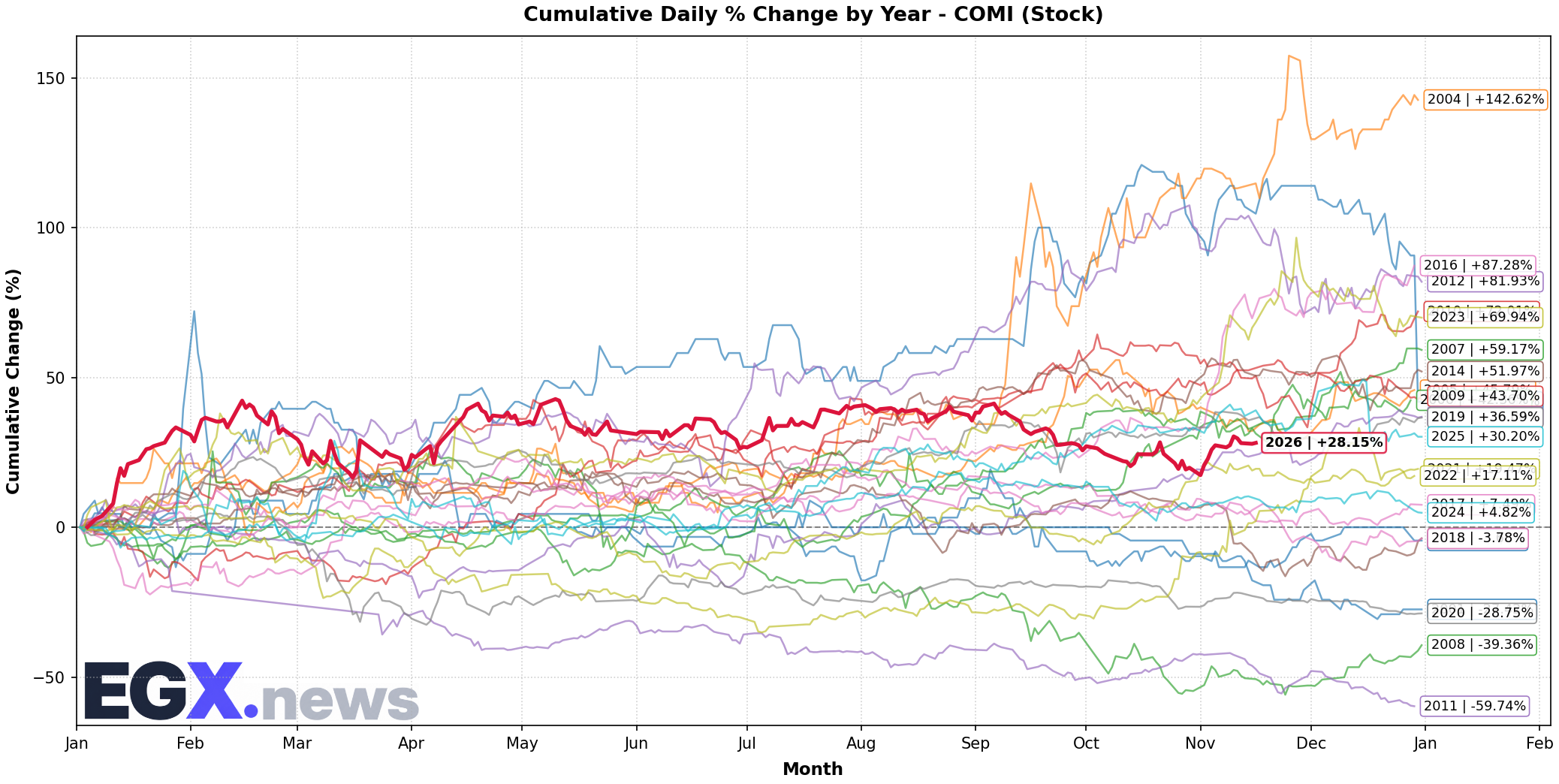
COMI Technical Analysis: The stock trades near the level of 85 pounds, holding above the 200-day moving average (around 83 pounds). The current level forms a historically strong demand zone. Breaking 83 pounds opens a target of 78 pounds, while breaking the resistance at 88 pounds with trading volume returns the stock toward 95 pounds. The expected dividend yield exceeds 7 percent, providing strong price support.
#### Other Defensive Sectors
- Telecommunications (Telecom Egypt, Vodafone Egypt): Revenues in pounds linked to dollars (international capacities), regular cash dividends, inelastic demand for services.
- Basic Consumer Goods (Juhayna, Edita, Domty): Ability to pass on costs, stable demand, reasonable valuations.
- Fertilizers (Abu Qir, Mopco): Export prices supported by global demand, fixed local gas costs, high profit margins.
#### Sectors the Report Currently Avoids
- High-Beta Real Estate: Extreme sensitivity to interest rates and financing costs, and a long cash conversion cycle.
- Indebted Conglomerates: Risks of refinancing short-term debt at high interest rates.
- Low-Liquidity Speculative Stocks: The most affected by liquidity drying up and speculators withdrawing.
Upcoming Catalysts: Roadmap for the Session and Week
| Catalyst | Expected Date | Potential Impact |
|---|---|---|
| EGX30 Holding Above 51,500 with Trading Volume | Sunday / Monday Session | Technical: Short-term rebound signal, attracting local liquidity |
| Coverage and Pricing of Misr Life Insurance Offering | This Week | Fundamental: Testing institutional appetite, injecting new liquidity |
| Fed Meeting Minutes (FOMC Minutes) / Dot Plot Projections | Wednesday, 25 November | Macro: Decisive for dollar path and global interest rates |
| Launch of Q3 2026 Earnings Season | Starting This Week | Fundamental: Selective catalyst for stocks with outstanding results (banks, fertilizers, telecommunications) |
| IMF Executive Board Approval (Disbursement of $2.3 billion) | During November | Macro: Reserve support, rating agency confidence, exchange rate stability |
| Treasury Bill Yield Spread vs Stock Exchange Dividend Yields | Ongoing | Liquidity: Narrowing the spread is a necessary condition for foreign return to stocks |
Conclusion and Strategic Recommendations
The Egyptian Exchange faces a decisive technical test at the 51,500-point level, in a hostile external environment lacking cheap global liquidity. The base scenario favors relative stability of the main index supported by Egyptian and Arab purchases in defensive leading stocks, while the 70 index continues to fluctuate.
Operational Recommendations:
1. Reduce marginal positions in high-risk and low-liquidity stocks.
2. Build/Enhance positions in major bank stocks (COMI, CIB, QNB) and telecommunications and basic consumer goods at current support levels, targeting total return (dividends plus medium-term capital gains).
3. Monitor trading volumes closely: Any rebound without real volumes is considered a "technical rebound" to sell into.
4. Risk Management: Strict stop-loss orders below the 51,400-point level for the general index.
The Egyptian market remains a "Value Story" in a world seeking real returns, but entry timing requires patience and strict selectivity until global monetary tightening winds stabilize.
Live Egyptian Equities Coverage
Track real-time quotes, order book market depth, and quantitative technical analytics for all 299 listed companies.
Open Real-Time Market Terminal →