


Morning & Opening Report: Egyptian Exchange at a Technical and Geopolitical Crossroads - 23 November 2026
Executive Summary
The Egyptian market opens today's session on the back of a sharp technical collapse that hit major indices, with the Market Health Index recording a low reading of 36.1 out of 100, the EGX30 breaking the psychologically significant 50,000-point barrier, and the EGX70 declining 5.5% in yesterday's session. This broad-based decline — characterized by severely negative market breadth (advance/decline ratio of 0.09) — comes as an inevitable result of a toxic interplay between a global risk-off wave led by US technology markets and domestic structural pressures represented by continued foreign outflows for the thirteenth consecutive session. Conversely, long-term fundamental anchors remain supportive, led by 4.9% GDP growth in Q1 FY 2026/2027, a $33.1 billion oil investment pipeline, and the upcoming Misr Life Insurance stake offering expected to inject EGP 2.2 billion. The critical support at 49,500 points on the EGX30 remains the last line of defense to avoid accelerated technical deterioration.
---
Global & Regional Context: Geopolitical Risks and Tight Monetary Policy
Global Market Developments
Global markets witnessed violent volatility over the past week, with the Nasdaq erasing nearly $4 trillion in market capitalization, declining 5% weekly, before recording a 2.8% technical rebound in its futures early today — a move classified in technical literature as a "Dead Cat Bounce" unless accompanied by a fundamental shift in liquidity drivers. Meanwhile, gold jumped 2.1%, reclaiming the $3,600/oz level, driven by unprecedented geopolitical escalation following the US administration's threat to resume strikes on Iran after the New Year if nuclear negotiations falter, injecting a high dose of uncertainty into global risk-asset pricing.
Regional Repercussions
Arab bourses ended Sunday's session on sharp collective losses, tracking the negative US close, with the Saudi market experiencing a broad-based collapse that drove 14 stocks to all-time lows. This negative regional cohesion reduces the likelihood of attracting alternative Arab liquidity to the Egyptian market in the near term and increases the burden on local liquidity to absorb foreign selling pressure.
---
Domestic Macroeconomic Indicators: Solid Anchors Amid a Liquidity Storm
| Indicator | Latest Reading | Implication |
|---|---|---|
| GDP Growth (Q1 2026/2027) | 4.9% | Confirms real economy resilience and capacity to absorb external shocks. |
| Planned Oil Investments | $33.1 Billion | Provides long-term visibility for hard currency cash flows and budget support. |
| 91-Day T-Bill Yield | 26.29% | Reflects very high opportunity cost for equities, pressuring earnings multiples. |
| IMF Program | Upcoming Review for $2.3B Disbursement | Cornerstone for exchange rate stability and foreign institutional investor confidence. |
| Misr Life Insurance Offering | Expected EGP 2.2 Billion | Real test of market depth and local institutions' capacity to absorb offerings. |
The Prime Minister affirmed the priority of localizing import-intensive industries, while the Planning Minister revealed development and service projects exceeding EGP 5 billion in Suez, and the Suez Canal Axis seeks to deepen partnership with Greek companies in industry and ports. These moves establish an improved business environment, but they offer no immediate liquidity relief to the secondary market.
---
Technical Analysis & Market Structure: Signs of Capitulation and Systematic Distribution
EGX30 Index

The EGX30 decisively broke the 50,000-point barrier, converting this level into strong psychological and technical resistance. The close below the 50-day moving average, accompanied by relatively high volumes in down sessions, confirms seller dominance. The 49,500–49,600 point zone represents pivotal support coinciding with the 61.8% Fibonacci retracement of the recent uptrend. A daily break below this level opens downside targets toward 47,800 points (78.6% retracement). Technical indicators (RSI, MACD) are in deeply oversold territory, raising the probability of a limited technical bounce (pullback) to test the breakdown, but the overall trend remains bearish unless the index reclaims 50,500 points.
EGX70 EWI Index

The EGX70 recorded a violent 5.5% decline, reflecting broad-based capitulation in the small- and mid-cap segment rather than selective profit-taking. Market breadth is severely damaged, with advancing stocks not exceeding 13.8% (advance/decline ratio of 0.09). Restoring confidence requires a sustainable return of this ratio above 0.3. Current technical support lies near the early November low; its failure would deepen the corrective path toward mid-year levels.
Qualitative Technical Signals (Market Internals)
- ZEOT (Zion): Faced critical resistance with a long upper shadow forming 68.5% of the session's range — a classic pattern of rejection and institutional distribution.
- HRHO (Hermes): Recorded volume of 3.94x the daily average without corresponding price action (Volume Climax without Price Action), a classic fingerprint of "market maker traps" or trapped liquidity being unwound, often preceding further decline or an extended horizontal consolidation.
---
Sectoral Focus & Leading Stocks: Divergence in Resilience
Banking Sector: Relative Haven Under Opportunity Cost Pressure
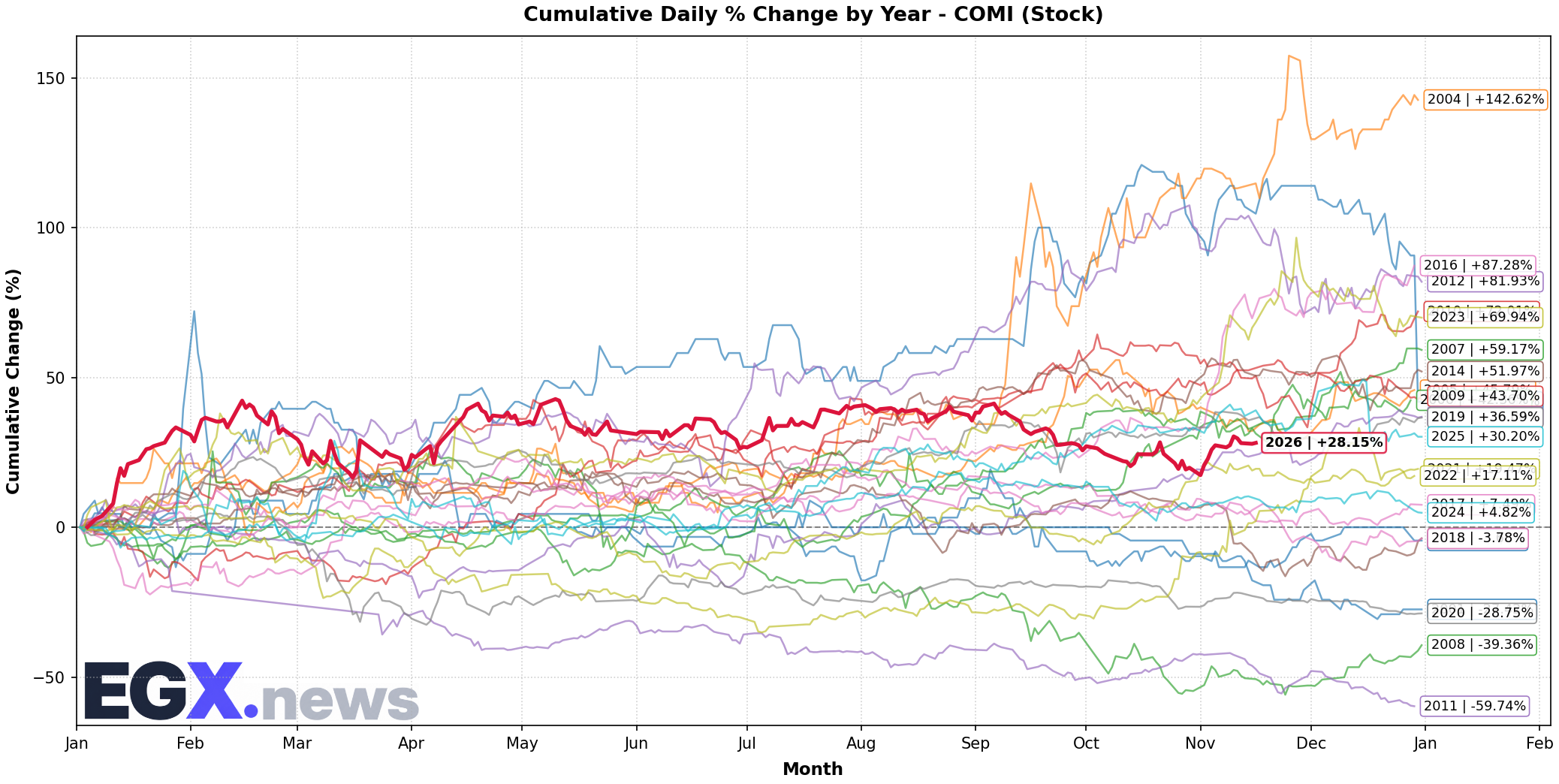
Commercial International Bank (COMI): The stock maintains an organized corrective structure above the 200-day moving average support, backed by a strong balance sheet and generous dividend yield. However, the 26.29% T-bill yield imposes a difficult ceiling on the price-to-book multiple. A downside break of the ~EGP 85 level would shift the medium-term trajectory to negative.
Industrial & Chemical Sector: Bet on Import Substitution & Energy Pricing
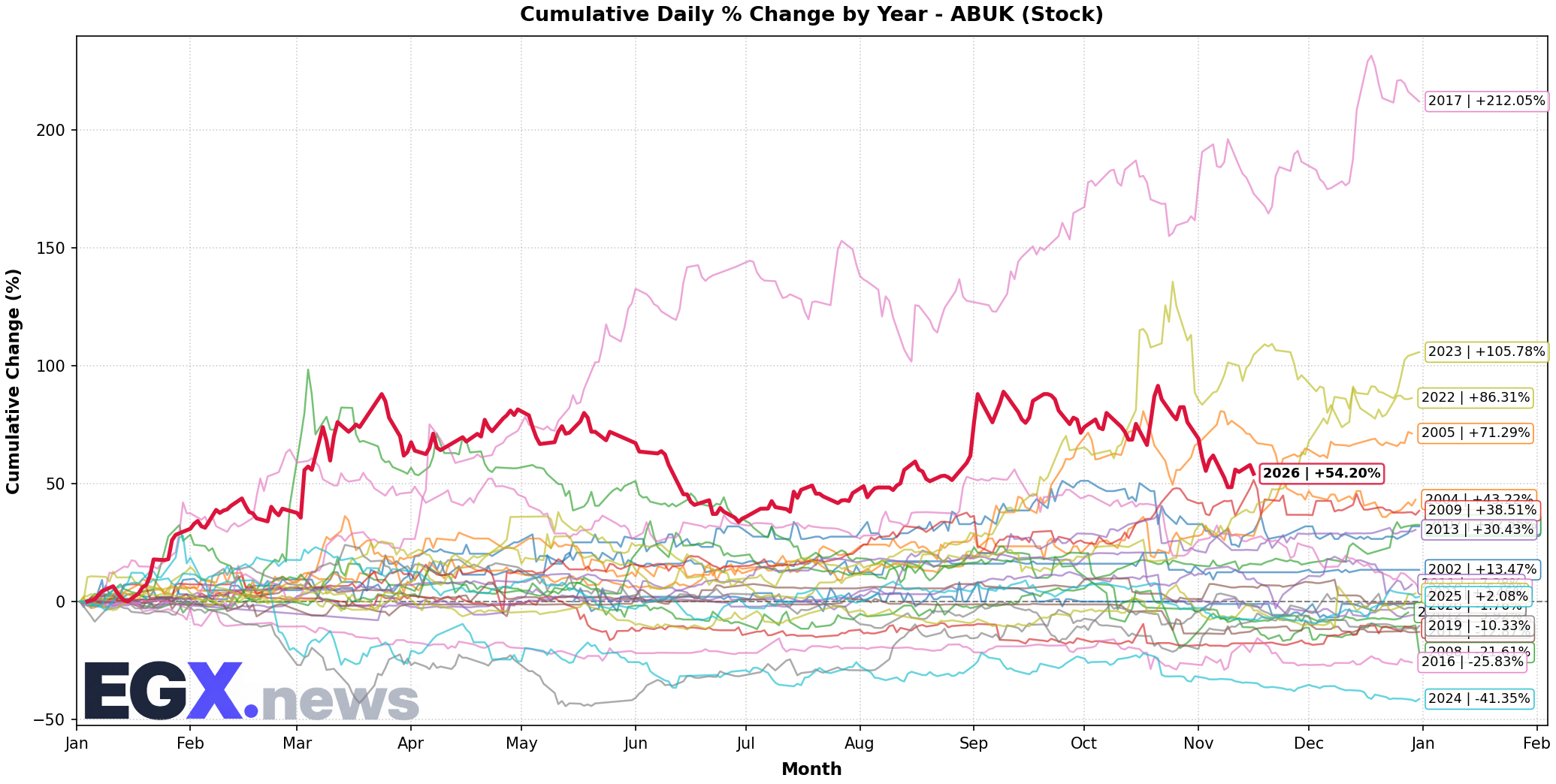
Abu Qir Fertilizers (ABUK): Strategically benefits from the state's drive to localize import-intensive industries and from natural gas prices linked to long-term contracts. Technically, it holds above key support at the ~EGP 30 level, making it a candidate to lead any sectoral rebound driven by positive oil sector news.
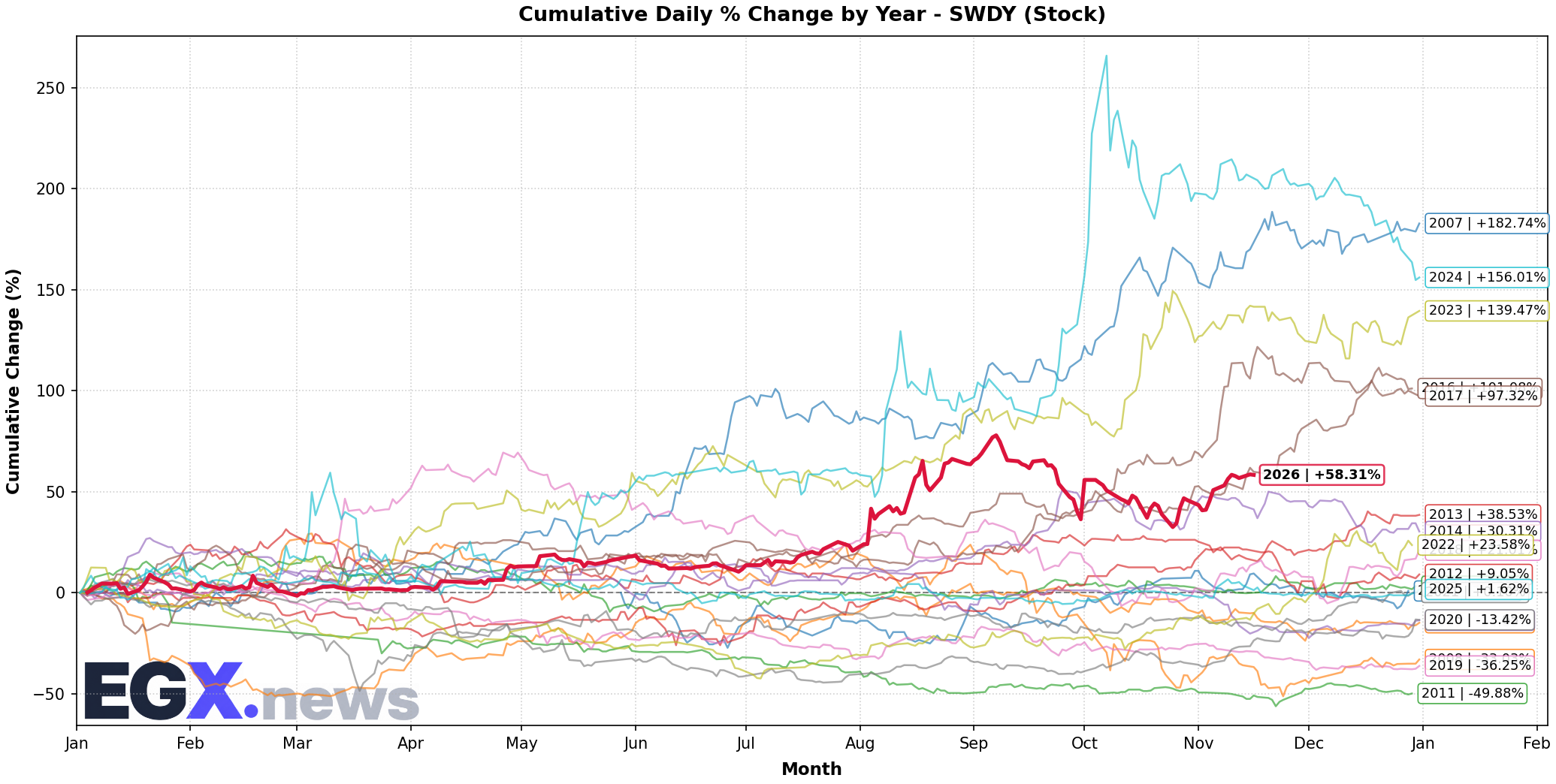
Elsewedy Electric (SWDY): Represents a direct proxy for the infrastructure and electricity investment program ($33.1B oil + Suez projects). The stock is testing crucial technical support at the 100-day moving average. Its ability to hold here is linked to new contract flows and quarterly earnings announcements.
Real Estate Sector: High Sensitivity to Interest Rates & Liquidity
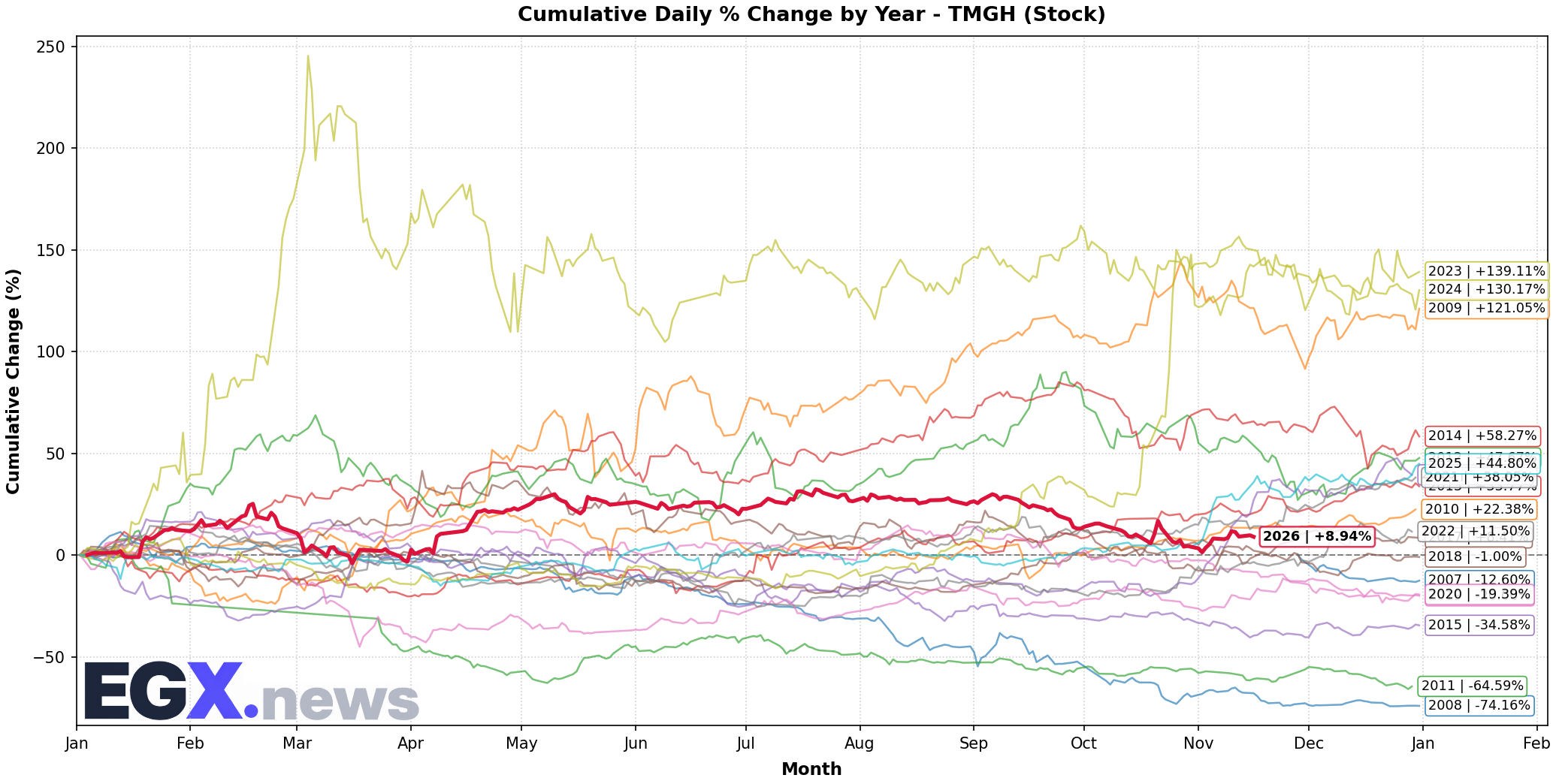
Talaat Moustafa Group (TMGH): Most affected by the high interest rate environment and financing costs. The stock breaks successive supports with no technical signs of a near-term bottom. Any sectoral improvement is contingent on clear signals from the Monetary Policy Committee toward a rate hold or cut, or the success of the "Misr Life Insurance" offering in injecting new liquidity to absorb supply.
---
Liquidity Dynamics & Institutional Flows: Anatomy of the Crisis
| Axis | Current Status | Implications |
|---|---|---|
| Foreign Investor | Net Seller for 13 Consecutive Sessions | Primary source of downside pressure; exit reflects EM risk repricing and expected Fed hike in December. |
| Local Investor (Institutions) | Net Buyer but with Diminishing Absorption Capacity | Local funds absorb supply, but available liquidity erodes with the allure of T-bills (26.29%). |
| Arab Investor | Neutral to Seller | Impacted by sharp losses in Gulf markets, particularly Saudi Arabia. |
| Retail (Egyptians/Foreigners) | Volatile / Panic Selling | Negative breadth (13.8% advancers) indicates broad participation in selling. |
The Liquidity Paradox: The market possesses strong fundamental anchors (4.9% growth, $33B investments, structural reforms), but "price" is determined by the "margin" (Marginal Buyer/Seller). The margin today is a foreigner selling out of fear, and a local buying with caution capped by the T-bill cash ceiling. Breaking this vicious cycle requires an external catalyst (Fed pause, IMF disbursement) or a domestic one (successful offering, surprise rate cut).
---
Key Catalysts & Risk Factors: Roadmap for Upcoming Sessions
Positive Catalysts (Upside Triggers)
1. EGX30 Holding Above 49,500 Points: Necessary condition for any technical recovery attempt.
2. Reversal of Foreign Flows: Even a single session as net buyers would be a strong signal of marginal seller stabilization.
3. IMF Executive Board Approval: Disbursement of the $2.3 billion tranche per the announced schedule removes "delay" risk from pricing.
4. Misr Life Insurance Subscription Coverage: Successful offering with broad institutional and retail participation injects new liquidity and restores confidence in the government offering mechanism.
5. Brent Stabilizing Above $90: Supports oil revenues and reduces import bill pressures.
Downside Risks
1. Break of 49,500 on EGX30: Technically opens the path toward 47,800 points and triggers institutional stop-loss orders.
2. Fed Rate Hike in December (Currently Priced In): Would widen the yield gap in favor of the dollar and T-bills, increasing the allure of the risk-free alternative.
3. Geopolitical Escalation in Gulf/Iran: Drives gold higher and emerging equities lower, with risk of maritime navigation disruption.
4. Global Tech Earnings Revisions: Continued selling in Nvidia/Anthropic keeps global risk appetite suppressed.
5. MPC Decision Dec 17: Any surprise rate hike (unlikely but possible) would be a knockout blow to equity multiples.
---
Outlook & Strategic Positioning: Cautious Vigilance Awaiting Pivots
Base Case (60% Probability): Choppy Consolidation.
The market tests the 49,500–49,600 support with relative success, oscillating in a tight range (49,500–50,500) until clarity emerges from the Fed meeting (Dec 18), MPC meeting (Dec 17), and IMF disbursement. Liquidity will remain scarce, and extreme selectivity in stocks with real cash yields and strong balance sheets (select banks, fertilizers, utilities) is the optimal strategy.
Alternative Bear Case (30% Probability): Support Break & Accelerated Decline.
Failure of the 49,500 support pushes the EGX30 toward 47,800 and the EGX70 to mid-year levels. In this scenario, the yield gap between equities and T-bills widens, and volumes retreat to genuine drought levels.
Alternative Bull Case (10% Probability): Early Strong Rebound.
Release of decisive positive news (early IMF, surprise Fed pause, Misr Life Insurance offering covered multiple times) triggers a violent short-covering rally targeting 51,500 then 53,000 points.
Operational Recommendation:
- For Medium/Long-Term Investors: Build gradual positions (DCA) in quality names with inflation-protected cash flows (COMI, ABUK, SWDY) at current technical support levels, with position sizes below usual norms awaiting monetary path clarity.
- For Short-Term Traders: Avoid "catching a falling knife." Focus on limited technical bounces (scalping) on the EGX30 at 49,500 with very strict stop-loss orders.
- Risk Management: Reduce total portfolio gross exposure to 60–70%, raise cash/T-bill allocation as dry powder to exploit pricing dislocations should a final capitulation occur.
Live Egyptian Equities Coverage
Track real-time quotes, order book market depth, and quantitative technical analytics for all 299 listed companies.
Open Real-Time Market Terminal →